

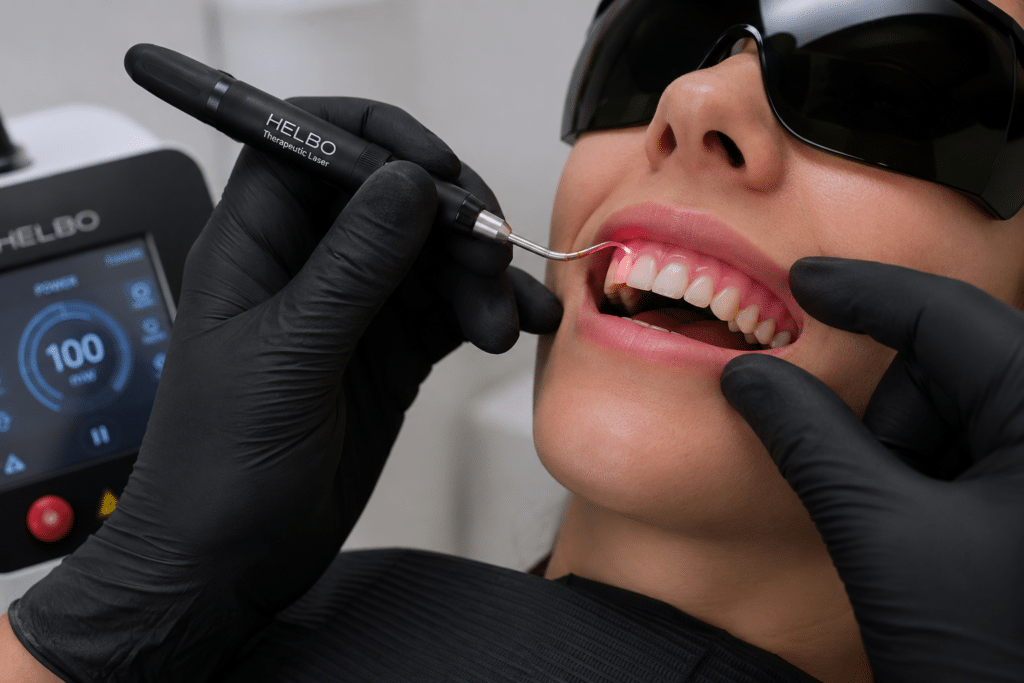
Photodynamic Therapy (HELBO) in Periodontal Therapy
Treating periodontitis systematically – gently complemented without antibiotics.
Periodontitis is a chronic inflammation of the periodontium caused by bacteria – if left untreated, it can lead to gum recession, bone loss and ultimately tooth loss. At smileDentity in Dreieich, we complement systematic and supportive periodontal therapy (SPT) for selected patients with photodynamic therapy (aPDT) using the HELBO laser – an antibiotic-free, gentle additional procedure for targeted germ reduction in the gum pocket.
Trust at a glance
- Andreas Haas | M.Sc. | Dentist – 20+ years of experience
- Performed by our dental hygienists B. Lemkadem and R. Großkopf
- Antibiotic-free additional therapy instead of reflexive antibiotic prescribing
- Transparent information about benefits, evidence and limitations
- Cost transparency – no hidden costs
- 5.0/5 star rating
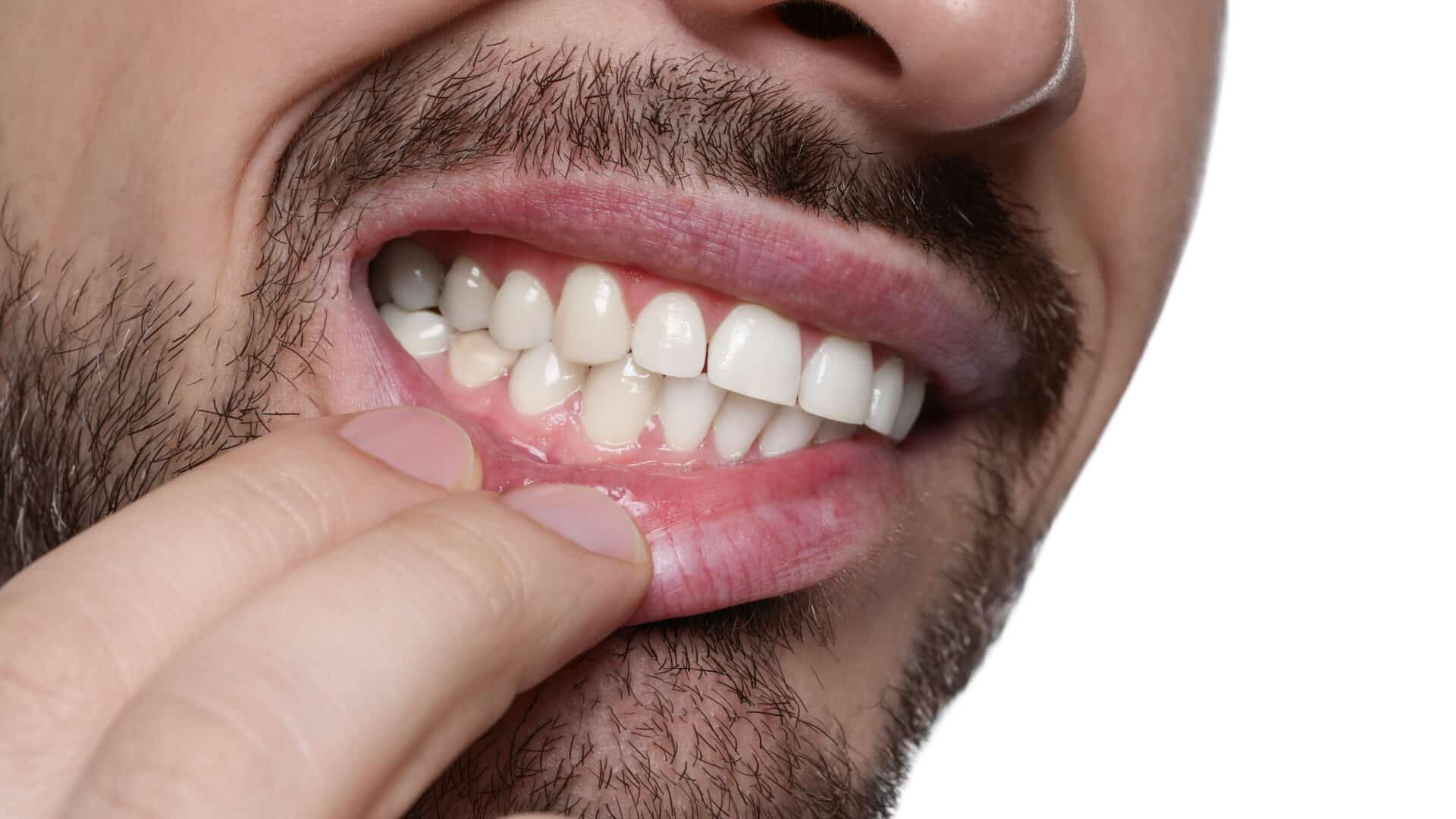
What is periodontitis – and why does it need systematic therapy?
Periodontitis is caused by a bacterial biofilm (plaque) that settles below the gum line and triggers chronic inflammation. Typical signs are:
- Bleeding gums, even with light touch
- Gum recession and exposed tooth necks
- Bad breath (halitosis)
- Loose teeth in the advanced stage
- Deepened gum pockets (probing pocket depth)
According to the Fifth German Oral Health Study, over 50% of adults in Germany are affected by periodontitis. If left untreated, it leads to an irreversible loss of tooth-supporting tissue. In addition, there are scientifically well-documented links between periodontitis and general diseases such as atherosclerosis or type II diabetes mellitus.

The basis of all periodontal therapy: subgingival instrumentation
The foundation of every periodontitis treatment is and remains subgingival instrumentation – the thorough mechanical removal of the bacterial biofilm and tartar from the root surfaces. From an evidence-based perspective, there is no way around it. Photodynamic therapy is to be understood as a complement to, not a replacement for, this mechanical cleaning.
What is photodynamic therapy (aPDT) with the HELBO laser?
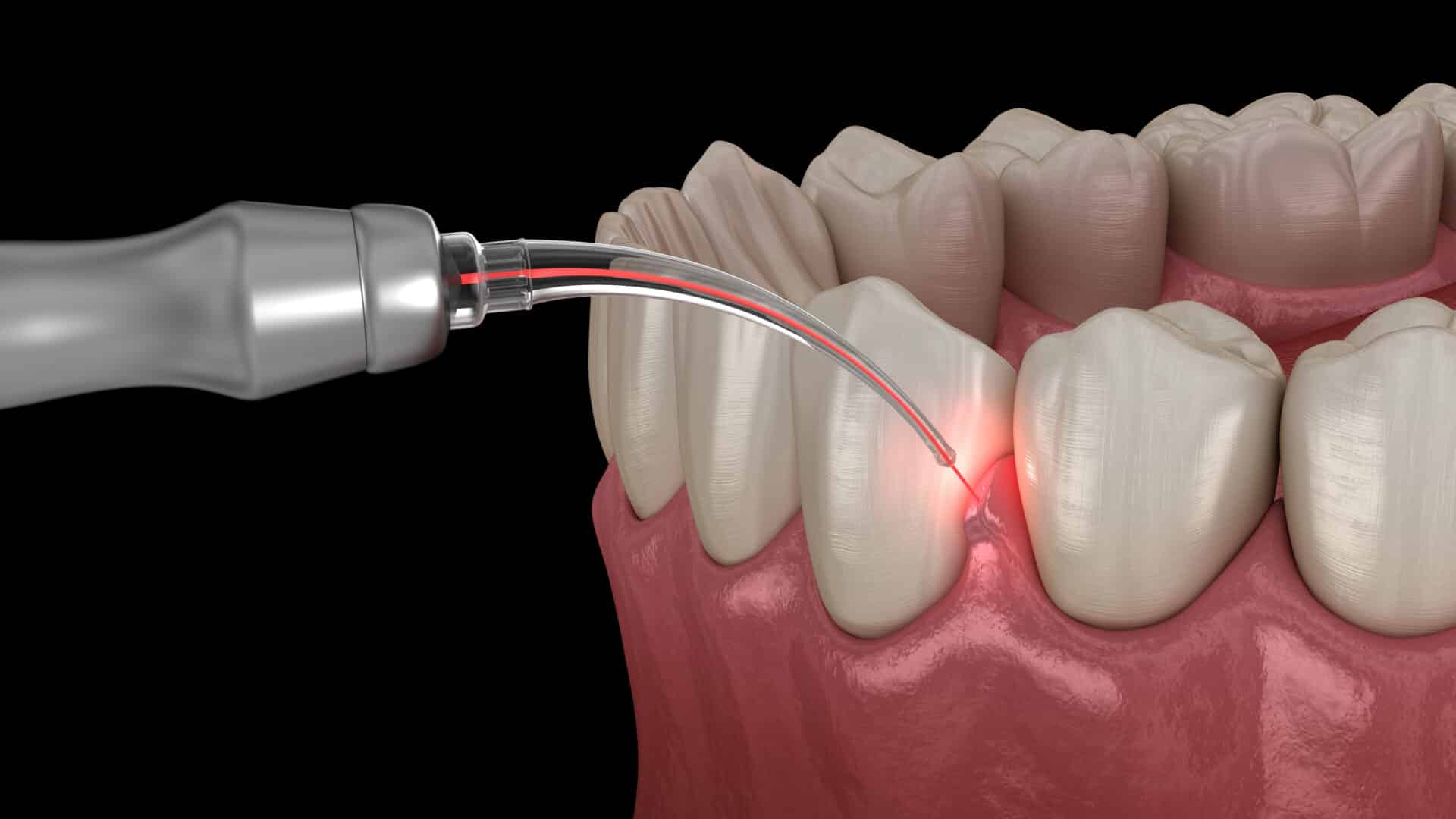
Antimicrobial photodynamic therapy (aPDT) uses the interaction between a photosensitiser (a dye-based active substance) and laser light of a specific wavelength:
- Applying the photosensitiserThe dye is introduced into the gum pocket, which has previously been mechanically cleaned, and attaches specifically to the bacterial cell walls.
- Laser activationThe pocket is irradiated with the HELBO laser for around 60 seconds.
- Photochemical effectReactive singlet oxygen is produced, which destroys the cell membrane of the stained bacteria – photochemically, not through heat.
- Gentle on tissueSurrounding, unstained body tissue is not damaged in the process.
The decisive difference from an antibiotic: there is no resistance problem, as the mechanism of action is purely physico-chemical. The application is painless and usually requires no additional anaesthesia.
When do we use photodynamic therapy at smileDentity?
At our practice, photodynamic therapy with the HELBO laser is, as a matter of principle, used as an addition to mechanical instrumentation, in particular:
- As part of SPT for individual residual pockets after active treatment
- When antibiotic-free additional therapy is expressly requested
- As a complement in the treatment of peri-implantitis
- Alongside therapy for bacterially caused halitosis
Important to know: Photodynamic therapy never replaces thorough mechanical cleaning – it is always used in combination with it and decided on individually based on the findings.
Photodynamic therapy for periodontitis – what does the science say?
We deliberately do not want to promise more here than the current body of research supports.
What is established:
- The photochemical mechanism of action is well described in basic research and widely studied internationally.
- aPDT is considered a well-tolerated procedure with few side effects and no development of resistance – a relevant advantage over systemic antibiotics.
- International systematic reviews show a short-term advantage (after 3 months) in reducing probing pocket depth, as a complement to subgingival instrumentation.
What the evidence does not clearly show
The German S3 guideline “Subgingival Instrumentation” (DG PARO/DGZMK) currently does not recommend a single adjuvant aPDT as part of primary therapy (recommendation grade ↓, low level of evidence). The underlying meta-analysis found a statistically significant but clinically small additional effect (0.21 mm additional pocket depth reduction) with strong heterogeneity of study methods.
For the long-term effect (from 6 months) and repeated applications, robust, methodologically high-quality studies are still lacking.
The research is also inconsistent with regard to wavelengths, photosensitisers and treatment protocols.
Who may photodynamic therapy be suitable for – and who not?
Possible candidates: Patients in SPT with individual residual pockets and with a wish for an antibiotic-free additional option.
No substitute for mechanical instrumentation, for necessary systemic antibiotics in aggressive forms of the disease, or as the sole initial measure without prior cleaning.
We use photodynamic therapy as one possible option among several – tailored to your individual findings.
Our specialists in photodynamic therapy
At smileDentity, the treatment is in the hands of our two dental hygienists – with more than 70 years of experience in periodontology between them.
 Buschra LemkademDental Hygienist (DH), ZMPWorking in dentistry since 1995, with a professional focus on periodontology and supportive periodontal therapy (SPT). Particular focus on the empathetic care of anxious patients. More about prophylaxis, SPT & teeth whitening with Buschra Lemkadem →
-
Roswitha GroßkopfZMF | DH | Licensed NaturopathWorking in preventive dentistry since 1977 – over 45 years of patient experience. Dental hygienist training represents the highest internationally achievable qualification in SPT and individual prophylaxis. Specialist areas: systematic and non-surgical periodontal therapy as well as halitosis therapy.

“Many of my patients deliberately want to rule out antibiotics. With photodynamic therapy, I can respond to exactly that – targeted, gentle germ reduction in the gum pocket, entirely without the risk of resistance. It does not replace thorough cleaning, but it gives us an honest, additional option.”
 Buschra LemkademDental Hygienist (DH)
Procedure for HELBO treatment at smileDentity
- Periodontal diagnosticsRecording of probing pocket depths, bleeding on probing and findings per tooth/region.
- Mechanical instrumentationThorough subgingival cleaning as the indispensable basis.
- Photosensitiser & laser activationApplication of the dye, irradiation with the HELBO laser (approx. 60 seconds per pocket).
- Follow-upAs part of the ongoing supportive periodontal therapy (SPT).
Costs of photodynamic therapy (HELBO) at smileDentity
The costs depend on the number of teeth to be treated, the individual findings and the material required. As a guide, treatment at our practice starts at €280.
As adjuvant photodynamic therapy is not part of the standard care covered by statutory health insurance, it is an individual additional service. In the consultation, we will provide you with a transparent, individual cost estimate in advance.
Book your periodontal diagnostics appointment in Dreieich now
Bleeding gums, bad breath or first signs of gum recession – have the findings properly investigated. We advise you in detail, transparently and without promises of a cure on all options of periodontitis therapy, including photodynamic therapy.
What you should know about photodynamic therapy (HELBO)
A procedure in which a photosensitiser is introduced into the gum pocket and then activated with laser light. The singlet oxygen produced in the process specifically destroys the cell walls of the stained bacteria – photochemically, without heat and without antibiotics.
No. Mechanical subgingival instrumentation remains the indispensable basis of every periodontitis therapy. Photodynamic therapy is used exclusively as a complement to it.
The evidence is mixed: international reviews show a short-term advantage in pocket depth reduction, while the German S3 guideline currently does not recommend a single adjuvant application in primary therapy. Robust long-term data are still lacking.
The main advantage is that there is no resistance problem, as the mechanism of action is purely photochemical. In addition, the application is usually painless and well tolerated.
Our dental hygienists Buschra Lemkadem and Roswitha Großkopf – both with many years of experience in periodontology.
From €280, depending on the number of teeth treated, the individual findings and the material required – always with an individual cost estimate in advance.
No, adjuvant photodynamic therapy is currently not a standard benefit of statutory health insurance.
In addition to classic periodontal therapy and SPT, as a complement for peri-implantitis and bacterially caused halitosis.