

Professional Bleaching
Changing tooth colour — with individual planning
Bleaching can lighten natural teeth. At our practice in Dreieich, we first assess the cause of discolouration and your dental health. We also discuss your wishes. Our glossary entry on bleaching explains the basics; for its place in the overall smile, see Smile Enhancement.
Coffee, tobacco and pigments such as those in red wine can contribute to discolouration. Ageing, certain medicines such as tetracyclines, or increased fluoride intake during tooth development can also alter tooth colour. External deposits and discolouration within the tooth require different approaches. We recommend professional dental cleaning according to your findings and existing oral hygiene. The instructions for fläsh Light Whitening specify professional teeth cleaning 1–2 weeks before whitening. We examine and advise you before bleaching. We discuss whether we consider professional cleaning necessary or whether it is unnecessary in your particular case. We may photographically document the starting shade and findings.

What needs to be clarified before bleaching?
Dark or yellowish teeth are not always solely an aesthetic concern. Before whitening, we examine the teeth and gums. Decay, leaking fillings and possible disease must first be assessed and treated if necessary. The pre-bleaching check considers the starting shade, existing restorations and desired result. During this examination and consultation, you also receive your individual recommendation regarding professional teeth cleaning.
Crowns, partial crowns, bridges, veneers and resin fillings do not whiten like natural tooth structure. This can create colour differences. Replacement is not automatically necessary: we assess whether the difference bothers you and whether adjustment is appropriate. If aesthetic restorative treatment is already planned, tooth colour forms an early part of treatment planning. Will fillings and crowns become lighter?
In-office bleaching with fläsh
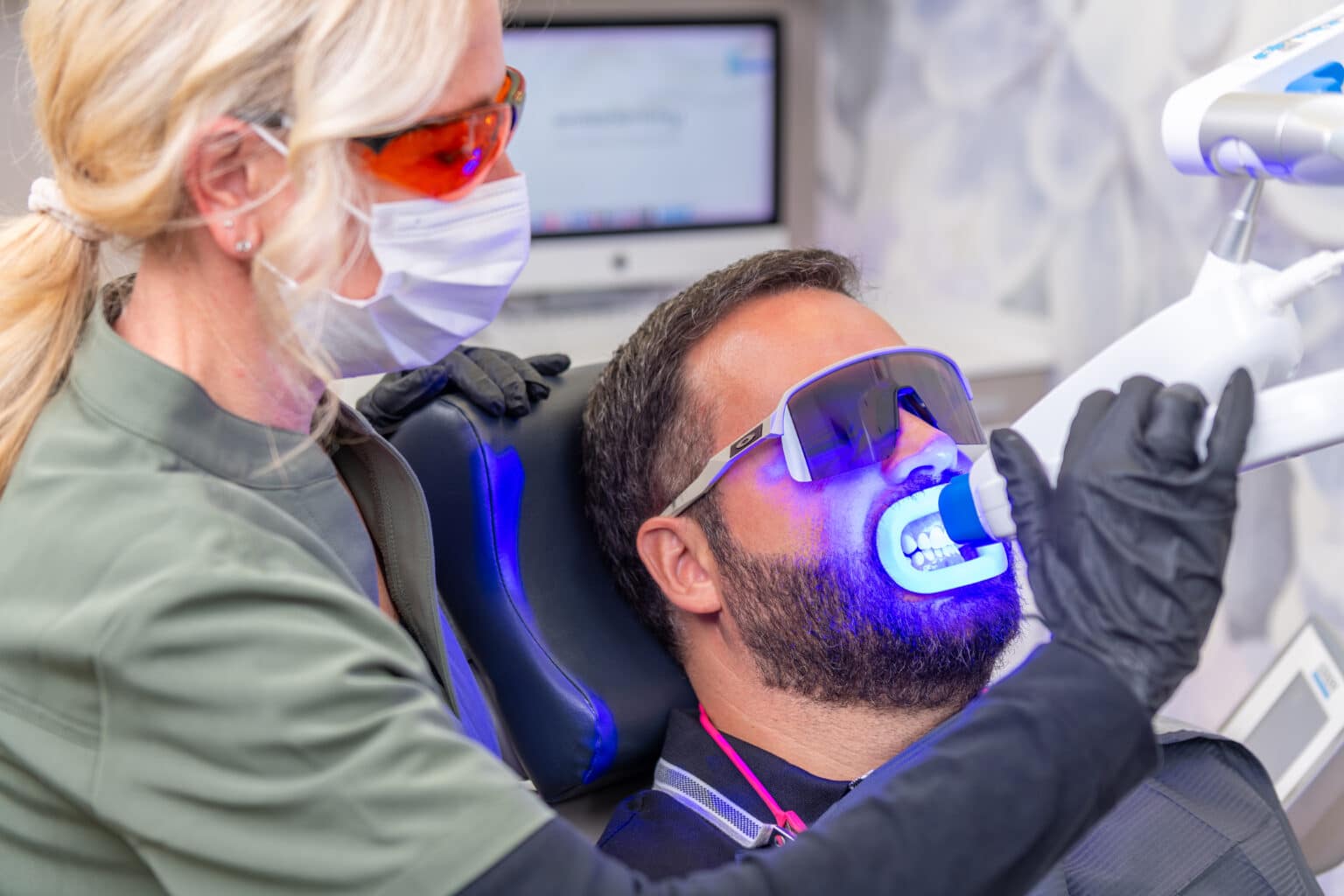
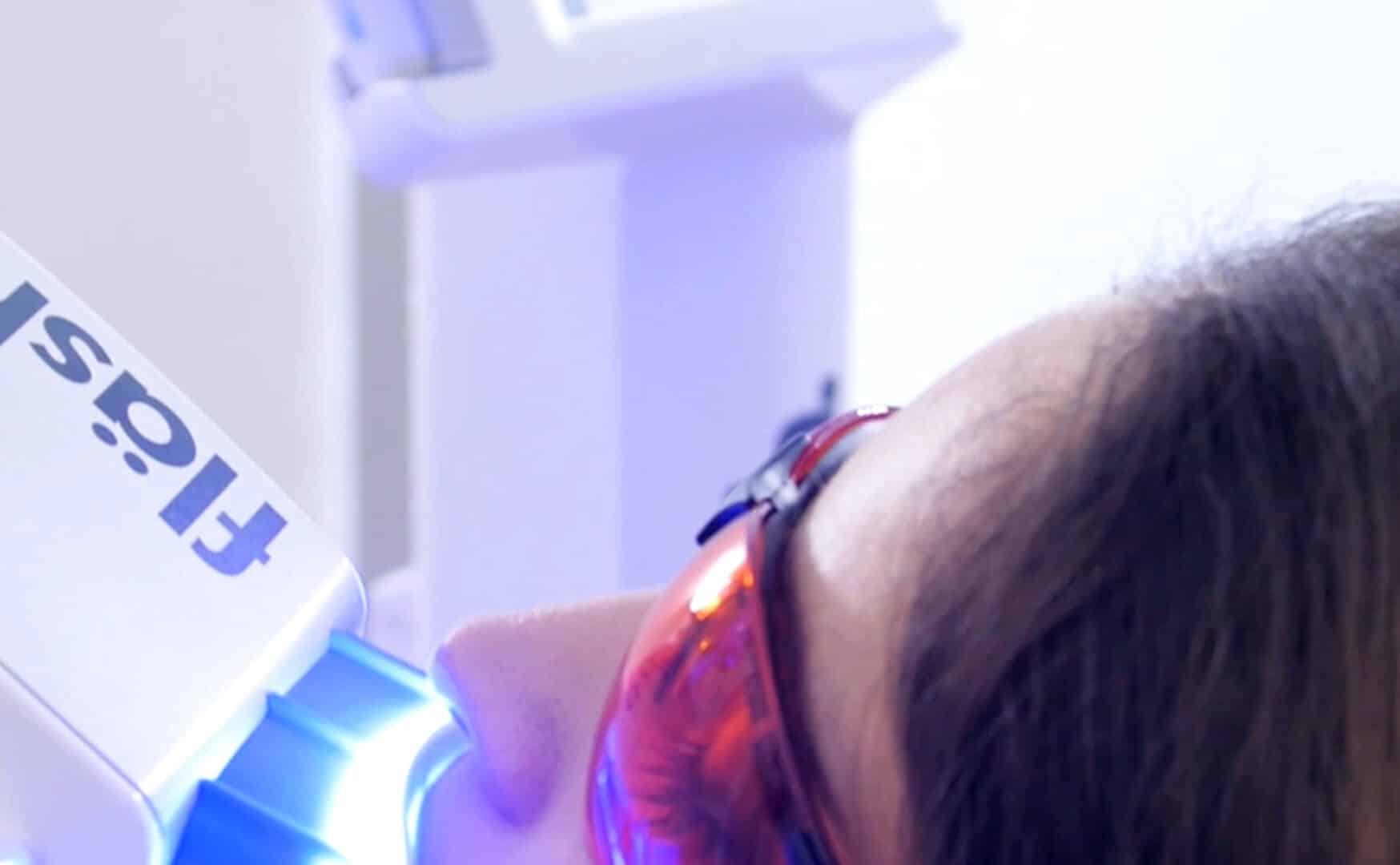
For in-office or power bleaching, we apply the gel under professional supervision at our practice. A liquid rubber dam covers the gums; concentrated gel must not contact unprotected oral mucosa. The fläsh system combines a light-activated whitening gel with a matching LED lamp. According to the manufacturer, fläsh Light Whitening with 32% hydrogen peroxide is intended for medically indicated whitening of pathologically severely discoloured teeth in adults aged 18 and over. [3]
Allow approximately 1.5 hours for the appointment. Up to four treatment cycles are possible in one session. We adapt concentration, application and preparation to the chosen product and your findings. During treatment, we adjust the number of cycles to your individual situation.
Whitening may be immediately visible. The possible change of 4–8 shades is a guide, not a promise: the starting colour, type of discolouration and individual response influence the result. We decide individually whether a final fluoride application is appropriate. It is not required after every bleaching treatment.
Dentist-supervised home bleaching
For home bleaching, you apply the selected gel at home according to our dental instructions, usually using suitable trays. Lower-concentration products and repeated applications spread treatment over a longer period. We tailor wear time and frequency to the product and your tolerance. Please do not extend the application independently.
A change of 3–6 shades is a possible guide for home bleaching. This range is not an individual prediction either. As with in-office bleaching, we discuss product selection, application and checks with you. If pain or marked irritation occurs, stop the application and speak to us. Over-the-counter whitening products do not replace this examination and guidance.
Internal bleaching of a single tooth
If a root-filled tooth has darkened internally, internal bleaching may be an option. We first assess the cause, the condition of the root canal treatment and an appropriate seal. We then place the whitening agent inside the tooth in a controlled manner. Several appointments may be needed.
This procedure differs from external bleaching of vital teeth. It is not suitable for every discolouration and has its own risks, including rare external cervical root resorption. We decide whether whitening, a restorative solution or another treatment first is appropriate based on the individual tooth.
Whitening, duration and costs at smileDentity
In-office bleaching with fläsh: Fixed price of €520 including VAT; treatment takes approximately 1.5 hours. The possible change of 4–8 shades is a guide, not a promise.
Home bleaching: €400–450 including VAT for the upper and lower jaws, including both individually made bleaching trays and bleaching gel. Application takes approximately 1–2 weeks. Possible whitening: 3–6 shades. Specific costs are planned individually in advance according to findings and the work involved.
Internal bleaching: Possible whitening: 5–7 shades. A guide of 1–3 appointments; additional applications or checks may be needed. We prepare an individual cost plan in advance according to findings and treatment requirements, without a flat-rate price.
Whitening varies between individuals; no specific result is guaranteed. We discuss necessary preliminary treatments and their costs in advance.
Possible side effects and limitations
With appropriate selection and application, bleaching is an established option for teeth whitening. Side effects are possible even with careful application, such as temporary tooth sensitivity and gum irritation. Sensitivity cannot be explained solely by dehydration; the effect of peroxides on the tooth also plays a role. Symptoms often subside. Please contact us if pain is persistent or severe so that we can investigate the cause.
Fillings and dental restorations are not automatically damaged, but their colour does not change correspondingly. Material and marginal quality are therefore included in the examination. A very bright or completely uniform result is not always achievable. We discuss limitations and alternatives, particularly for pronounced internal discolouration.
How do we work at smileDentity?
When planning aesthetic treatment, Andreas Haas, M.Sc., considers your tooth colour, dental health and existing restorations. Together we discuss what you would like to change, which method may be suitable and which preliminary treatment is appropriate. Choosing not to whiten your teeth is also an option.
Our dental hygienists Buschra Lemkadem and Roswitha Großkopf support your teeth whitening at smileDentity under dental responsibility. We discuss questions and dental anxiety beforehand.
We explain application or aftercare and how we check the result. Discuss any important upcoming events with us in good time so that whitening and any later colour adjustment of restorations can be coordinated appropriately. For the final shade assessment, we also consider how tooth colour develops after the immediate first impression. We explain the stated prices before treatment; for home and internal bleaching, we prepare an individual cost plan based on findings and the work involved. Please bring any questions about sensitive teeth, existing fillings and preferred dates.
Bleaching: frequently asked questions (FAQ)
No. We first examine your teeth and gums and clarify the cause of discolouration. We discuss and assess decay, fillings or existing symptoms before purely aesthetic whitening.
Professional teeth cleaning is often appropriate to remove external deposits and assess the starting shade. The instructions for fläsh Light Whitening specify professional cleaning 1–2 weeks before whitening. At our practice, the recommendation is tailored to your findings and existing oral hygiene. After examination and consultation, we discuss whether we consider professional cleaning necessary or whether it is unnecessary in your particular case.
At our practice, we supervise the application directly. At home, you apply the gel over several sessions according to our instructions. Both approaches can whiten teeth. Together we choose the approach based on your findings, sensitivity and preferred timetable.
No, they do not whiten in the same way as natural teeth. A colour difference may become visible. We discuss with you whether adjustment or replacement is appropriate. Replacement is not an automatic consequence.
Durability varies individually. Dietary and lifestyle habits, oral hygiene and the original discolouration affect subsequent colour changes. We plan any later top-up only after reassessing your teeth; we cannot promise a particular permanent tooth colour.
Tell us about sensitive teeth beforehand. If symptoms occur at home, pause the application and contact us. We investigate severe or persistent pain before you begin further whitening cycles.
Sources and further information
- [1] American Dental Association: Whitening, Fachübersicht, Stand 2022
- [2] Bundeszahnärztekammer: Bleaching (Zahnaufhellung), Patienteninformation 2024
- [3] WHITEsmile: fläsh Light Whitening 32% HP – Gebrauchsanweisung REF202, Version 6.2 (10/2025): Zweckbestimmung, Eignung und Vorbereitung
Sources and links last editorially reviewed on: 27 October 2026.
Is bleaching right for your smile?
Get to know our practice and discuss your wishes regarding tooth colour. We clarify the possibilities, limitations and appropriate next step.
Medical review of the German source: On 28 October 2026, this content was reviewed by Andreas Haas, M.Sc. (dentist at smileDentity Dreieich) for medical accuracy, currency and scientific basis.