

Clarify the aim first
Tooth retention, socket preservation and preparation of an implant site require different measures tailored to the findings.
When bone or parts of the tooth-supporting structures have been lost, the original situation cannot always be fully restored. For suitable defects, regenerative procedures may help preserve tissue or rebuild it in a targeted way. At smileDentity in Dreieich, we distinguish between treating diseased teeth and preparing for an implant restoration. The findings determine which aim is achievable and which materials may be suitable. Here, we explain procedures using Bio-Oss®, Bio-Gide® and Emdogain® and their limitations.
A defect in the tooth-supporting structures differs from a jaw ridge that is too narrow before implant placement. For selected periodontal bone defects, regenerative surgery may be considered after initial treatment. The 2020 EFP guideline names options including barrier membranes and enamel matrix derivatives, sometimes combined with bone substitutes. Appropriate defect characteristics and adequate oral hygiene are prerequisites. [1]
Material selection follows the treatment aim. Not every material breaks down or is replaced by new tissue in the same way. We explain what is proposed for your treatment, where the material comes from and which alternatives exist. “Biological” does not automatically mean entirely derived from your own body or free from possible complications.
Bio-Oss® is a bone substitute based on processed bovine bone mineral. It acts as a scaffold for new bone formation. Its slow breakdown is characteristic; material particles may remain in the regenerated area over the long term. It is therefore incorrect to state generally that all the material is fully replaced by the body’s own bone after a short time. [2]
Bio-Gide® is a resorbable collagen membrane of porcine origin. Depending on the procedure, it is placed over the regeneration area and acts as a barrier. A separate procedure solely to remove such a resorbable membrane is not normally planned. Nevertheless, complications may require additional treatment. [3]
Materials and surgical technique are parts of an overall plan. A particular combination guarantees neither uncomplicated healing nor a fixed result after three or six months. Monitoring actual progress remains essential.
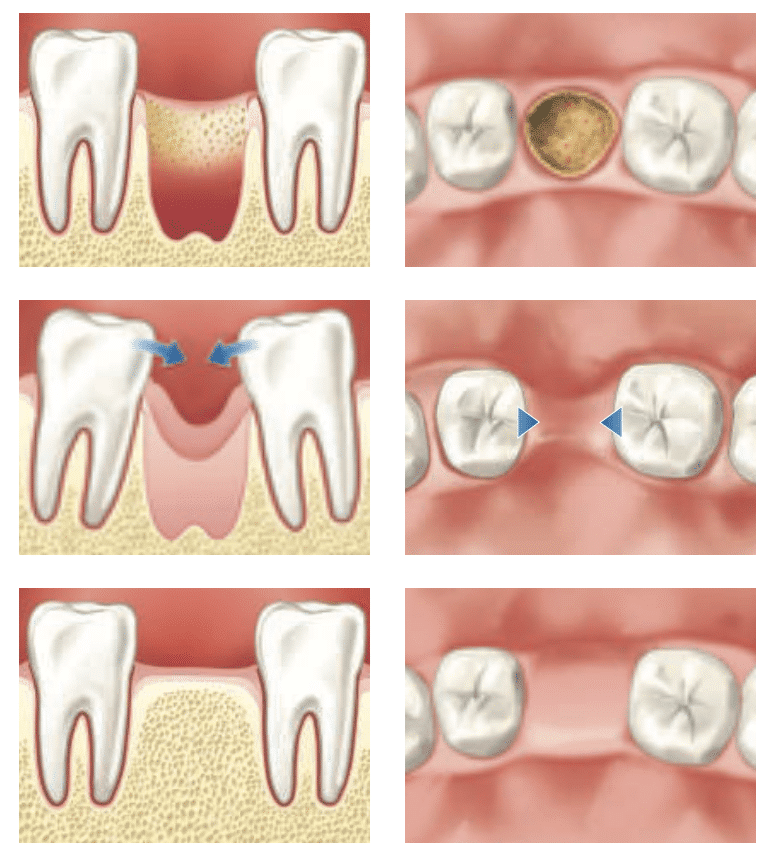
After tooth removal, the tooth-bearing part of the jaw changes. Socket preservation involves treating the socket to limit unfavourable changes in the area of the future restoration. Depending on the initial findings, a bone substitute and membrane may be used. This can matter before an implant or when a bridge is planned. It does not guarantee complete preservation of the original contour. [2] [3]
This measure is not automatically necessary after every extraction. We discuss its benefit for your planned restoration, possible alternatives and the consequences of not having it. Tooth removal that preserves tissue as far as possible remains part of the surgical approach.
The interim restoration also belongs in the plan: which provisional restoration is possible, how will the area be protected and when can a decision be made about the definitive restoration? Patience may be necessary, without a faster approach being inherently worse. Timing and readiness depend on the findings and healing progress.
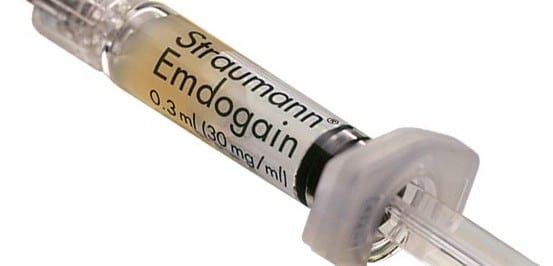
Emdogain® is a gel containing enamel matrix proteins of porcine origin. It is used in suitable periodontal treatment situations. The aim is to support processes important for regeneration of the tooth-supporting structures. The product is not a mineral substitute for filling any type of jawbone defect. [4]
Where appropriately indicated, enamel matrix derivatives may form part of regenerative periodontal surgery and certain periodontal plastic surgery procedures. Indications and possible risks must also be assessed individually for repeat use; this does not imply a general assurance of safety. Reduced pocket depth and improved attachment are possible treatment aims, but do not mean guaranteed tooth retention or complete restoration. Initial treatment, defect shape, home care and subsequent support remain essential. [1]
If you wish to avoid animal-derived materials, raise this before planning. We explain which alternatives are available for your specific defect and how they differ.
We first clarify whether the tooth can be preserved or which conditions are lacking for your planned restoration. Examination and appropriate imaging help assess the situation. This informs the proposed surgery, material choice and a plan for reviews and restorations. Additional PRF treatment using your own blood is a separate decision and does not replace this plan.
We explain the risks of the proposed procedure beforehand, such as discomfort, swelling, infection, impaired wound healing or insufficient tissue gain. We also discuss how we would identify and treat such problems. You receive appropriate care instructions and learn how to contact us if recovery is unusual. Further monitoring aims to establish whether the agreed goal is actually being achieved and whether the next step is appropriate.
Tooth retention, socket preservation and preparation of an implant site require different measures tailored to the findings.
Origin, function and breakdown differ. Ask about the proposed combination and alternatives.
Reviews and interim restorations are part of planning. The timetable remains a guide.
We coordinate regenerative measures with your planned tooth preservation or replacement. Andreas Haas, M.Sc., discusses which findings support or argue against the proposed procedure. The materials described here are Bio-Oss®, Bio-Gide® and Emdogain®; we explain the actual product variant proposed in your individual plan. During an introductory visit without obligation, you can experience our practice in person and discuss your questions.
We clarify treatment stages, provisional restorations, limitations and costs with you in advance. An itemised treatment plan helps you discuss reimbursement with your insurer. Without an examination, neither the quantity of material required nor the total time and cost involved can be stated reliably.
Complete restoration is not achievable in every situation. Ask about the specific aim: treating a defect around a tooth, preserving the contour after extraction or preparing an implant site? The individual recommendation follows this aim.
Bio-Oss® breaks down slowly. Particles may remain in the treated area over the long term. This distinguishes it from a resorbable membrane. We therefore explain the function of each proposed material separately.
A separate removal procedure is not usually planned for the resorbable membrane. This does not guarantee that no further treatment will be necessary later. We discuss what you should do if wound healing is unusual.
No. The potential benefit is assessed in relation to the defect, tissues and later restoration. Contour can also matter for a bridge; this does not imply a general need for additional surgery after every tooth removal.
No. The products described here are animal-derived: Bio-Oss® is based on bovine bone mineral, Bio-Gide® on collagen and Emdogain® on enamel matrix proteins of porcine origin. Raise personal concerns early and discuss suitable alternatives.
We determine this from your progress. We give an anticipated time frame and explain which findings are needed before the next step. We discuss your provisional restoration from the outset.
A general assurance is not possible. The scope depends on the findings, proposed surgery and materials. We explain the plan beforehand. Check with your insurer which services your policy covers.
Sources and links last editorially reviewed on: 20 October 2026.
Arrange a personal consultation about bone regeneration at smileDentity. We discuss your findings, possibilities, limitations and suitable next steps.
Medical review of the German source: On 28 October 2026, this content was reviewed by Andreas Haas, M.Sc. (dentist at smileDentity Dreieich) for medical accuracy, currency and scientific basis.
You need to load content from reCAPTCHA to submit the form. Please note that doing so will share data with third-party providers.
More InformationSpam protection for our contact form
We use Cloudflare Turnstile to prevent automated enquiries. With your consent, your IP address and browser information are transmitted to Cloudflare.
Your consent is saved and can be withdrawn in the cookie settings.
Privacy information