


Dental laser at smileDentity
Uses and limitations of the 810 nm diode laser.
A dental laser concentrates light of a defined wavelength and delivers energy to the treatment area in a controlled way. At smileDentity in Dreieich, we use an 810 nm diode laser. Depending on the findings, it is used on soft tissue or alongside dental treatment. Applications include surgery, implantology, periodontology and endodontics, as well as infection control, haemostasis, wound healing and pain management.
The laser does not automatically replace established treatment steps. In root canal treatment at smileDentity for example, careful mechanical preparation and irrigation remain essential. In periodontitis treatment at smileDentity the necessary steps also depend on the diagnosis and individual progress. We establish whether the 810 nm diode laser is appropriate for you before using it.
810 nm diode laser
How does an 810 nm diode laser work?
Laser stands for ‘Light Amplification by Stimulated Emission of Radiation’. Unlike ordinary light, laser light has a precisely defined wavelength. Its effect in tissue also depends on power, operating mode, exposure time, application and the characteristics of the target tissue.
Our 810 nm diode laser delivers energy that is absorbed by haemoglobin and pigmented structures, among other things. This allows precise cutting of soft tissue and coagulation of small blood vessels. Controlled use can improve visibility in the surgical field. However, this means neither sterile tissue nor that neighbouring structures necessarily remain unaffected. We adapt the settings and handling to the particular indication.
Applications
Where do we use the dental laser?
Endodontics and infection control
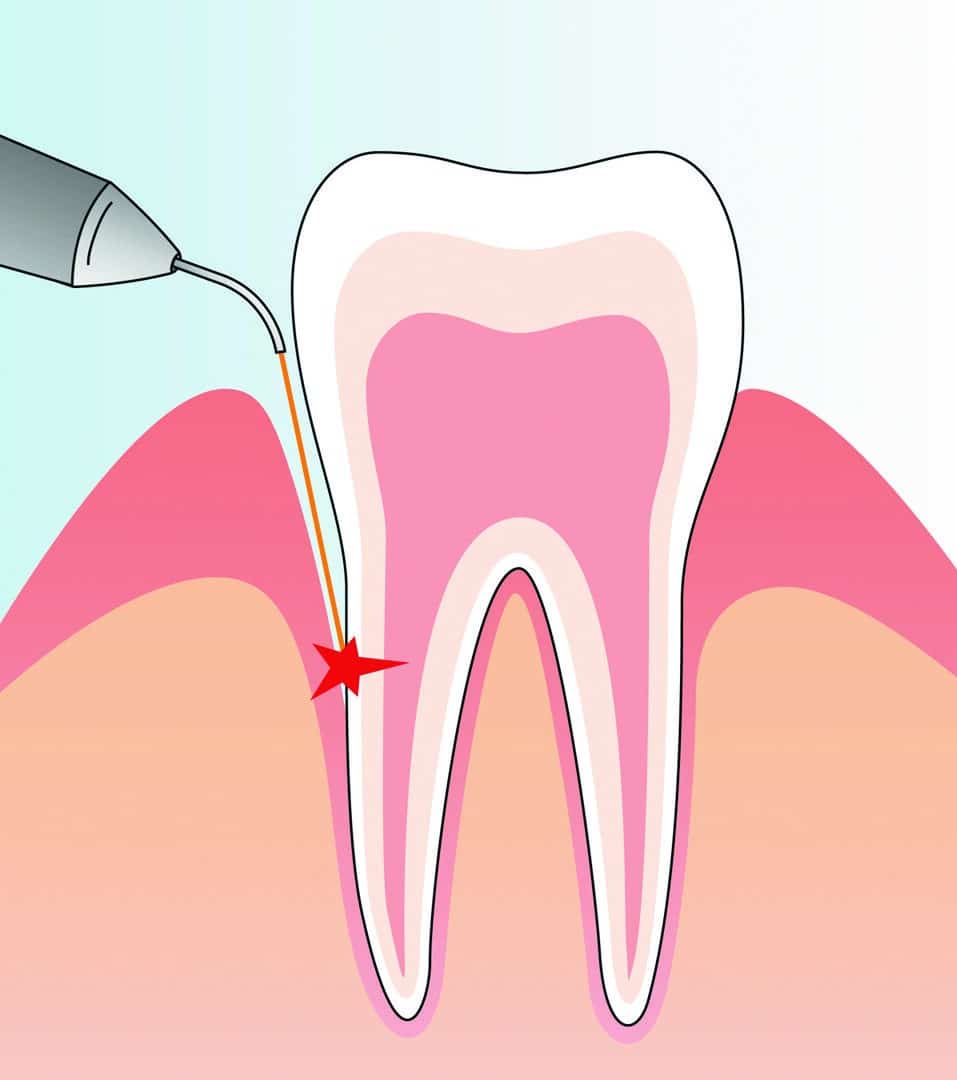
In endodontics, we can use laser energy as an adjunct to reduce microorganisms. It does not replace preparation, irrigation or filling of the root canal system. In our practice experience, supplementary laser use to reduce microorganisms in the root canal system is of great benefit and supports infection control.
Periodontology
For periodontitis, thorough subgingival instrumentation remains the central treatment. The 2020 EFP guideline does not suggest routine use of lasers or photodynamic therapy as adjuncts to this instrumentation. We therefore do not recommend a laser as an automatic standard addition and cannot promise protection against further bone loss. [1]
Surgery and implantology
We can use the diode laser on the gums for targeted surgical procedures and haemostasis, including in connection with implant procedures. In suitable minor soft-tissue procedures, this can often allow treatment without sutures.
Photobiomodulation
Wound healing, pain management and cold sores
At lower energy levels, we also use laser light as low-level laser therapy or photobiomodulation. Our applications include supporting wound healing and pain management, treating cold sores and — depending on the findings — smoothing scars. The aims and approach differ significantly from surgical laser use.
For herpes labialis, studies show possible benefits for pain and healing time; however, the available studies are small and mostly at high risk of bias. A particular outcome therefore cannot be promised. [3]
Aphthous ulcers differ from contagious cold sores. Before use, we therefore first establish which condition is actually present.

Your treatment appointment
What happens during a laser application
01
Findings and aim
We examine the affected area and clarify whether the laser is intended as the main instrument or as an additional step.
02
Information and protection
We explain the aim, alternatives and possible sensations. Everyone present wears eye protection appropriate to the wavelength. [4]
03
Application
We adapt power, exposure time and handling to the tissue and indication. Local anaesthesia may be necessary, depending on the treatment.
04
Aftercare
We check the result and provide guidance relating to the underlying treatment. Please contact us if symptoms increase or healing appears unusual.
Benefits and limitations
Potential benefits of our laser therapy at a glance
The benefits an 810 nm diode laser may offer depend on the findings, application and settings. The following points describe possible characteristics, not guarantees.
Additional reduction of microorganisms
Laser energy can complement selected treatments to reduce microorganisms. It does not replace mechanical cleaning and irrigation or make tissue sterile.
Supporting healing processes
Photobiomodulation may be used with the aim of supporting healing and helping with symptoms. Faster healing or freedom from pain cannot be promised.
Less bleeding in the treatment field
On soft tissue, the laser can coagulate small blood vessels and reduce bleeding. This can improve visibility; whether stitches are needed depends on the procedure.
Targeted soft-tissue treatment
Power, exposure time and handling can be adjusted to treat the intended soft tissue selectively. Nevertheless, neighbouring tissue does not automatically remain unaffected.
The 810 nm diode laser replaces neither the drill on hard dental tissue nor necessary treatment steps. Warmth, tingling, temporary discomfort and the need for aftercare remain possible.
What does laser treatment cost?
Costs depend on the underlying treatment and the type of laser application. Whether statutory or private health insurance or supplementary insurance covers the costs, and to what extent, cannot be answered in general terms. We explain the likely costs before treatment; you can then clarify possible reimbursement with your insurer.
At smileDentity
How do we work at smileDentity?
Andreas Haas, M.Sc., discusses the treatment aim with you and the role the 810 nm diode laser may play. The specific findings and a clear treatment plan are decisive. We therefore do not recommend laser use simply because the technology is available or as a blanket substitute for established methods.
If a laser is an option, we explain its use, alternatives, possible sensations and appropriate aftercare. In endodontics and periodontology, we place it within the overall treatment. For cold sores or a change in the oral mucosa, establishing the correct diagnosis comes first. This helps you understand beforehand which aim is realistic and what the limitations are.
Frequently asked questions about dental lasers (FAQ)
This cannot be guaranteed. Many applications are perceived as causing little discomfort; warmth, tingling or a brief pulling sensation are possible. Local anaesthesia may be necessary for surgical procedures. We discuss beforehand what to expect during your treatment and respond to your feedback.
At smileDentity, depending on the findings, we use the laser in endodontics or root canal treatment, surgery, periodontology and implantology, as well as for wound healing, infection control, pain management and low-level laser therapy. Further applications include cold sores, haemostasis and — depending on the findings — scar smoothing. Not every application is appropriate in every situation.
No. Our diode laser is mainly intended for selected soft-tissue applications and as an additional technique. It does not replace preparation of hard dental tissue with a drill. Mechanical preparation, irrigation and a tight seal also remain necessary in root canal treatment.
No. Periodontitis requires systematic treatment followed by maintenance. Subgingival instrumentation is the central step. Even with a laser, we cannot guarantee germ-free tissue, halted bone loss or permanently stable teeth. We determine from your findings whether to consider an additional application in your individual case.
Cold sores and aphthous ulcers are different conditions. Depending on the stage and findings, photobiomodulation may be used for cold sores to help with symptoms and healing; the evidence does not allow a guarantee of success. Aphthous ulcers are not contagious and are assessed differently. Unclear or persistent changes should be examined.
This depends on the specific service and your insurance cover or policy. A blanket assurance or rejection would not be reliable. We explain the likely costs before treatment. If necessary, clarify possible reimbursement with your insurer beforehand.
Sources for clinical context
- [1] European Federation of Periodontology: Treatment of stage I–III periodontitis, Step 2 – subgingival instrumentation and adjunctive therapies. Grundlage: Leitlinie 2020, ursprüngliche Gültigkeit bis 2025.
- [2] American Association of Endodontists: Position Statement – Use of Lasers in Dentistry.
- [3] Yang et al.: Photobiomodulation im Vergleich zu konventioneller Behandlung bei Herpes labialis. Systematischer Review und Metaanalyse, 2025.
- [4] American Academy of Pediatric Dentistry: Policy on the Use of Lasers for Pediatric Dental Patients, Revision 2022.
Sources and links last editorially reviewed on: 16 October 2026.
Let us discuss your treatment personally.
At smileDentity, we clarify whether a dental laser is appropriate for your concern, which alternatives are available and what costs to expect.
Medical review of the German source: On 28 October 2026, this content was reviewed by Andreas Haas, M.Sc. (dentist at smileDentity Dreieich) for medical accuracy, currency and scientific basis.