

Rubber dam Protection and moisture control during your treatment
A dry working area protected from saliva supports precise work.
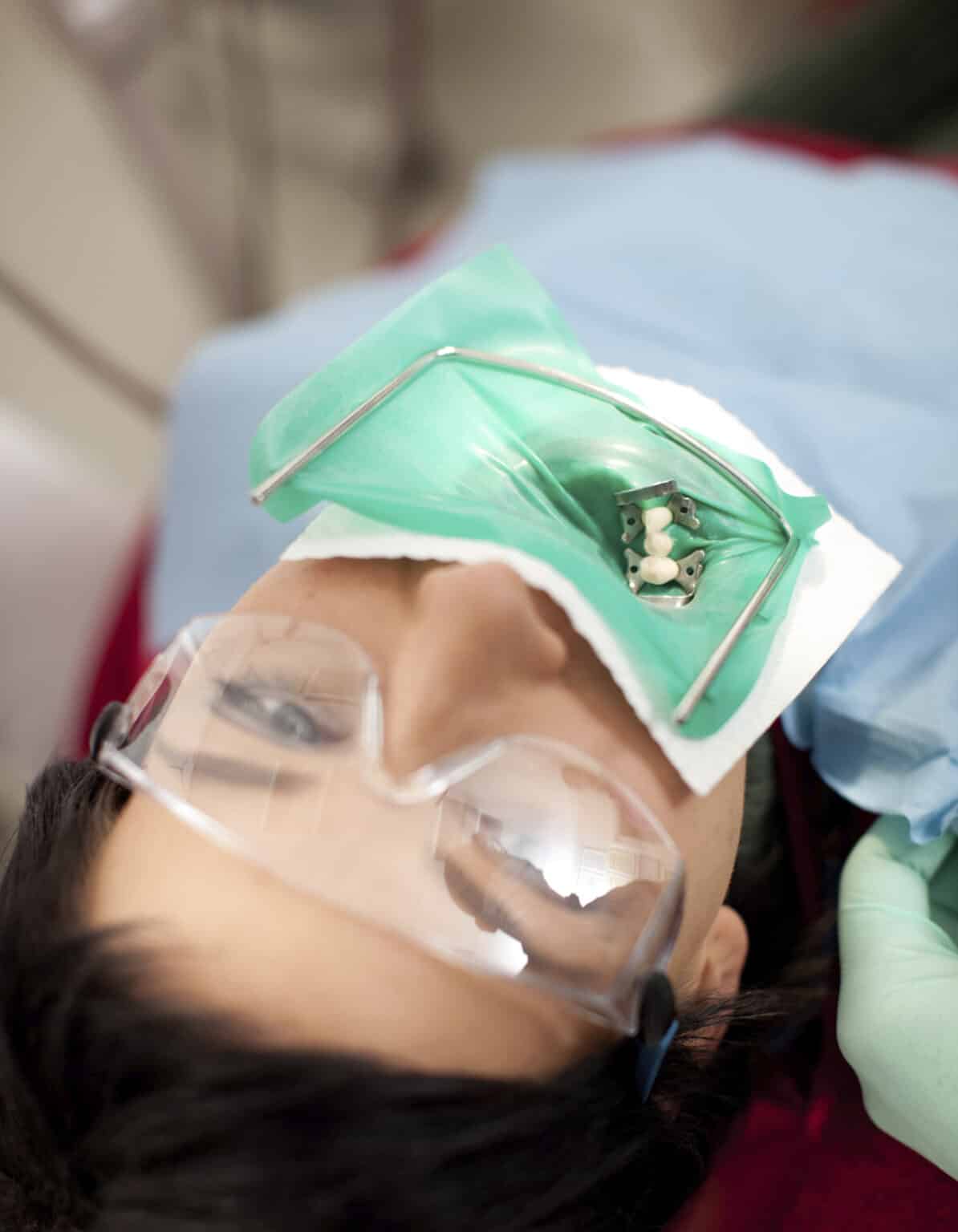
A rubber dam is an elastic sheet that isolates individual teeth or a group of teeth from the rest of the mouth. It is stabilised with a frame and, depending on the situation, a clamp, dental floss or other aids. This greatly reduces the amount of saliva and moisture reaching the tooth being treated. At the same time, the sheet keeps instruments, irrigating solutions and loose material fragments away from the throat. [1]
At smileDentity in Dreieich, we use a rubber dam for almost all dental and prosthetic treatments where a dry working area protected from saliva is important. These include in particular endodontics and root canal treatment at smileDentity, adhesive composite fillings and bonding ceramic restorations. It is usually not needed for check-ups, professional dental cleaning or whitening.
A rubber dam does not create a sterile or completely germ-free treatment field. It reduces contact with saliva, supporting controlled working conditions. How it is fitted and whether a latex-free version is needed depend on the treatment and your individual situation.
Rubber dam at smileDentity
What matters for your treatment
Working in a dry field
The rubber dam largely keeps saliva away from the treatment field and improves visibility.
Protecting patients
The sheet reduces the risk of swallowing or inhaling instruments, irrigating solutions or material fragments.
Individual adjustment
We adapt the fit, material and extent of isolation to your tooth, treatment and individual situation.
Why a dry foundation matters
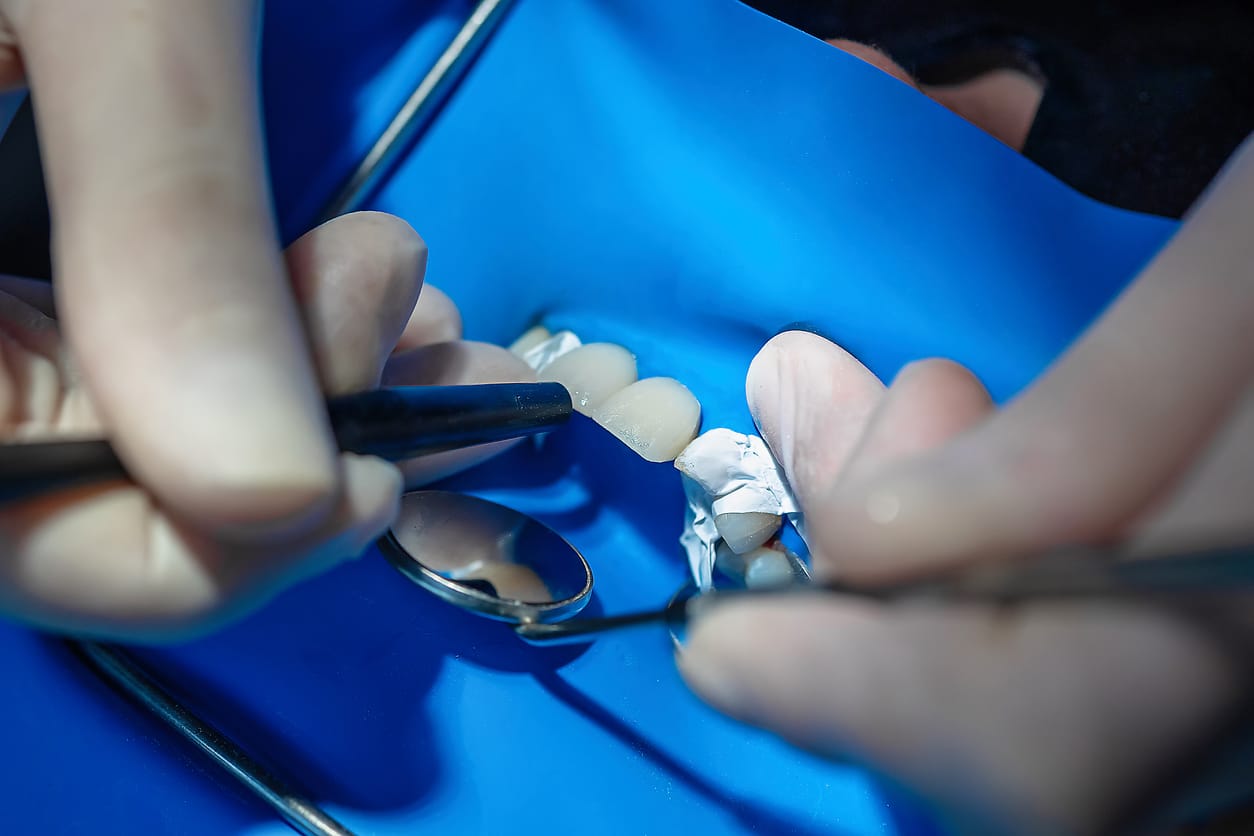
Adhesive fillings and ceramics: Composites and many ceramic restorations are attached to the tooth using a bonding system. This requires careful preparation of the tooth surface and protection from saliva during the key stages. A rubber dam supports this moisture control and improves visibility.
This is relevant, among other applications, for aesthetic anterior composite fillings and when placing inlays, onlays and partial crowns made from all-ceramic materials . A rubber dam can also isolate the working area when an existing amalgam filling is removed. Whether the filling needs replacing is decided separately on the basis of the findings. Good moisture control creates suitable conditions but does not guarantee a particular lifespan. A Cochrane review found indications of benefits after six months for selected direct restorations; evidence for longer periods was uncertain. [2]
Root canal treatment: Here, the rubber dam separates the opened tooth from saliva. It reduces the risk of recontamination and helps prevent fine instruments or irrigating solutions from reaching the throat. Endodontic treatment guidelines therefore describe it as an integral part of root canal treatment. [3]
At smileDentity
Precision under rubber dam — a feature of care at smileDentity
At smileDentity, we use rubber dam not only for root canal treatment and adhesive bonding. Andreas Haas, M.Sc., also uses it selectively when preparing teeth for ceramic and prosthetic restorations such as inlays, onlays, overlays, crowns and bridges, where the individual treatment permits. The coloured sheet visually separates the tooth from its surroundings. Combined with magnifying loupes, it makes fine preparation details and transitions easier to see and assess.
We suction away cooling water produced during preparation above the rubber dam. This largely prevents it from entering your mouth. It can reduce the urge to swallow and treatment interruptions. Preparation for extensive prosthetic reconstructions can take several hours; isolation then helps us maintain a calm, stable working area for a longer period.
Stable visibility and optical magnification support controlled instrument handling. Carefully finished preparation surfaces and clearly visible margins are an important foundation for well-fitting ceramic restorations. How we use rubber dam and magnifying loupes for you depends on your findings and the planned restoration.
Protection and comfort
What to expect during treatment
Benefits at a glance
- Protective barrier: The sheet separates the treated tooth from the tongue and cheeks and keeps irrigating solutions and loose material fragments away from the throat.
- Absolute isolation: A rubber dam isolates the treatment field more comprehensively than cotton rolls and a saliva ejector.
- Less water towards the throat: Many people find this more comfortable; suction may still be required, depending on the treatment.
- Reduced foreign-body risk: Instruments and material fragments are separated from the mouth. Additional securing and monitoring remain necessary.
- A possible sense of distance: Some people experience the treatment as less directly inside their mouth and find it easier to relax with music or mental distraction. Others initially find the sheet restrictive.
Absolute isolation — reliable separation of the treatment field
A rubber dam provides what is known as absolute isolation. The elastic sheet largely isolates the treated tooth from saliva, moisture and directly exhaled air. Compared with relative isolation using cotton rolls and a saliva ejector, it provides more comprehensive protection of the treatment area. This is particularly important for adhesive bonding, composite restorations and ceramic restorations because moisture contamination can impair the bond. ‘Absolute’ describes the isolation method, not a sterile or guaranteed completely dry working area.
After a short adjustment period, many patients find the sheet comfortable because less water reaches the throat and the tongue and cheeks are separated from the immediate working area. Others initially find the unfamiliar situation restrictive. Both are possible. Please tell us at any time if the clamp presses, the sheet is uncomfortable or you need a break.
During treatment, you generally breathe through your nose; depending on the position and design of the sheet, additional space may remain in the mouth area. Severely restricted nasal breathing, a pronounced gag reflex or a serious respiratory condition may make its use unsuitable or require adapted planning. [1] We clarify this before fitting the dam and monitor your comfort during treatment.
The rubber dam reduces the risk of swallowing or inhaling instruments or material fragments. It does not replace careful securing of the clamp, suction or ongoing monitoring by our treatment team.
Your treatment appointment
How we fit the rubber dam
01
Agreeing on treatment and material
We explain its purpose and ask about known latex or material allergies. A latex-free alternative is available where indicated by your allergy history.
02
Preparing the tooth and securing the clamp
We select the appropriate technique. A clamp can be anchored to the tooth and additionally secured with dental floss. We check its fit and stability carefully.
03
Stretching and sealing the sheet
We guide the sheet over the tooth or group of teeth and stretch it onto the frame. We then check the seal and adjust the fit.
04
Treatment and removal
After treatment, we carefully remove the sheet, clamp and aids. The outcome depends on the particular restoration and your individual circumstances.
Suitability and limitations
Not every situation can be isolated in the same way
Little remaining tooth structure, a tooth that has not fully erupted or very tight contact points can make attachment difficult. Material allergies, a pronounced gag reflex, serious respiratory conditions or an insufficiently secure placement must also be considered. [1]
If a rubber dam cannot be fitted securely and in a way you can tolerate, we investigate the reason and discuss how to proceed. The decision depends on the planned procedure; in root canal treatment, a rubber dam is not an optional comfort measure that can be freely substituted.
At smileDentity
How do we work at smileDentity?
Andreas Haas, M.Sc., adapts moisture control to the treatment and your dental situation. Rubber dam is part of our treatment approach for adhesive fillings, ceramic restorations and endodontic procedures. We explain beforehand why it is being used in your case and which alternative is suitable if you have a known latex allergy.
If you have questions or concerns about rubber dam, we discuss them with you beforehand. Together with Andreas Haas, M.Sc., you establish which options suit your individual situation so that treatment is as comfortable as possible. We explain any costs before treatment.
Frequently asked questions about rubber dams (FAQ)
Breathing is generally through the nose; depending on the position of the sheet, there may also be space in the mouth area. If nasal breathing is restricted or you have a respiratory condition, the situation must be assessed individually beforehand. Tell us immediately if you feel uncomfortable.
Many people mainly notice brief pressure when the clamp is fitted. However, sensitive gums or a difficult dental situation can cause discomfort. We check the fit, adjust the clamp if necessary and take breaks.
We use it for almost all dental and prosthetic treatments where a dry working area protected from saliva is important. These include root canal treatment, composite fillings and adhesively bonded ceramics in particular. It is usually not needed for check-ups, dental cleaning or whitening.
It supports suitable working conditions for adhesive procedures. However, actual longevity depends on many other factors. The scientific evidence does not allow a general lifespan guarantee for all fillings or ceramic restorations. [2]
Please tell us about known or suspected latex allergies. Where indicated by your history, we use a latex-free alternative. Other material intolerances should also be discussed before treatment.
Whether you incur out-of-pocket costs depends on the underlying treatment and the agreed scope of services. We explain possible costs or personal contributions before treatment.
Sources for clinical context
- [1] NHS Education for Scotland: Rubber Dam – Hints and tips for single tooth and quadrant isolation. Veröffentlicht 03.06.2026, Review vorgesehen 31.05.2028.
- [2] Miao C. et al.: Rubber dam isolation for restorative treatment in dental patients. Cochrane Database of Systematic Reviews, 2021.
- [3] British Endodontic Society: A Guide to Good Endodontic Practice, 2022.
Sources and links last editorially reviewed on: 16 October 2026.
Let us discuss your treatment personally.
Would you like to know whether a rubber dam will be used for your planned treatment? Arrange a personal discussion at smileDentity in Dreieich. We explain the process and answer your questions before the appointment.
Medical review of the German source: On 18 October 2026, this content was reviewed by Andreas Haas, M.Sc. (dentist at smileDentity Dreieich) for medical accuracy, currency and scientific basis.