

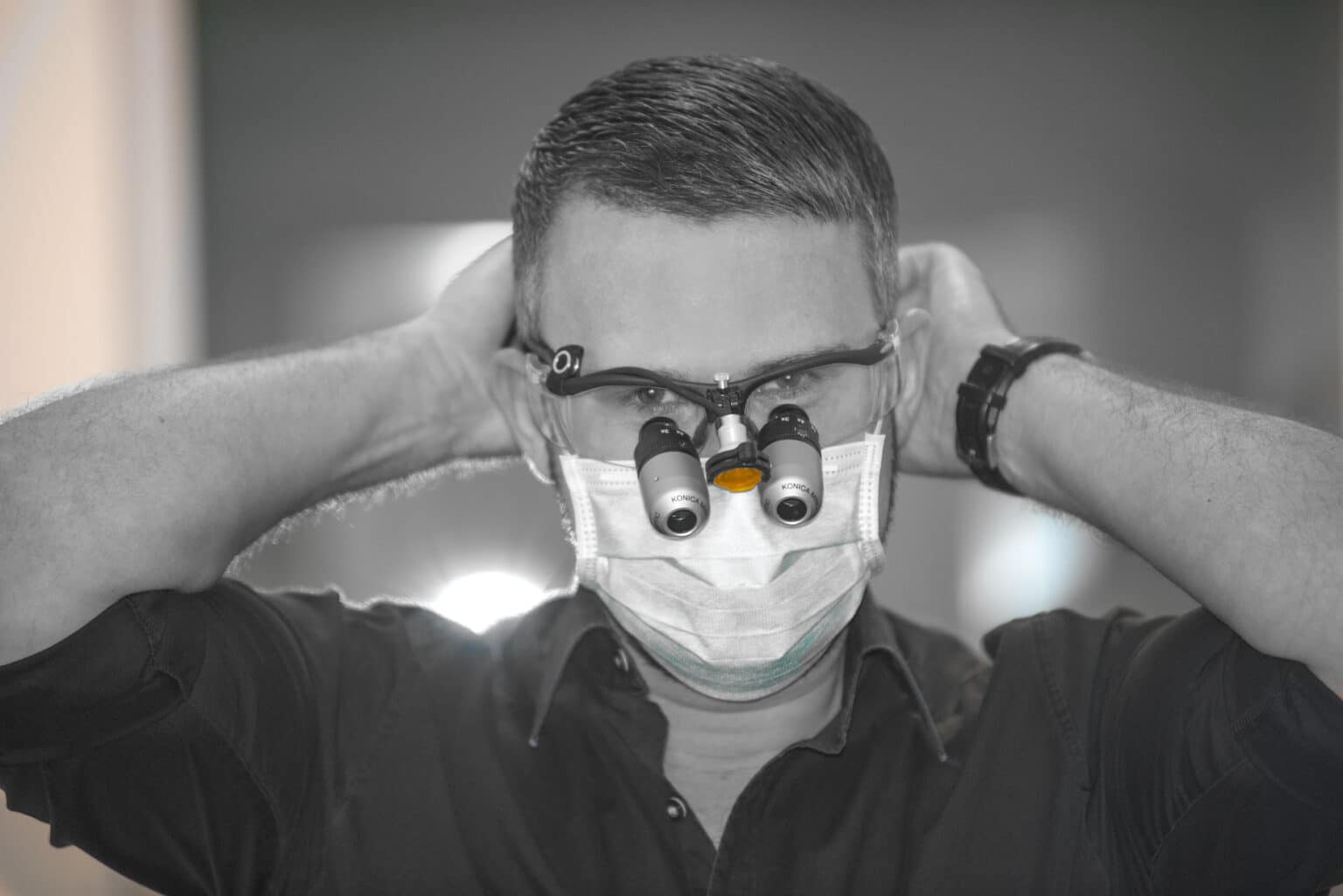
Precision with magnifying loupes
Recognising fine detail and carefully checking treatment steps.
Magnifying loupes enlarge the visible working area. At smileDentity in Dreieich, we use them as an optical aid for careful work, for example during Root canal treatment. Fine structures can become easier to recognise. The appropriate magnification depends on the task and working conditions. [1]
Our aim is a careful approach that preserves as much tooth structure as possible. Good visibility supports assessment of small working areas; it replaces neither diagnosis nor professional judgement. Magnifying loupes alone therefore do not guarantee a particular treatment outcome. [2]
Seeing more detail and assessing it carefully
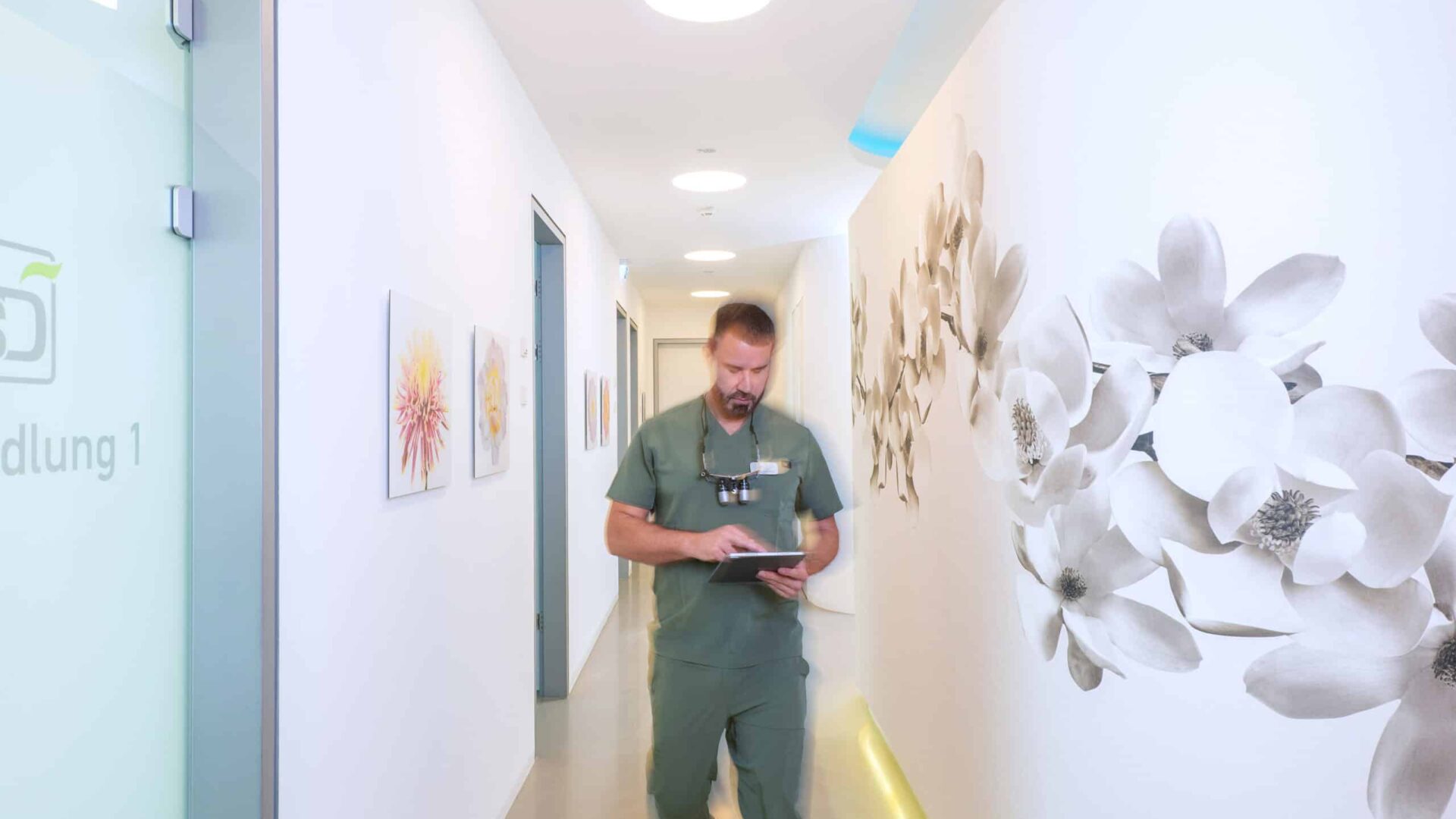
At smileDentity, we use different magnifying loupes with magnification from 2.8× to 5.0×. These include the Orascoptic EyeZoom with 3.0×, 4.0× and 5.0× settings. They enlarge the visible area. Areas that initially appear unremarkable to the naked eye can also be examined more closely. This does not mean that every apparently healthy tooth needs treatment. The findings determine the need for treatment.
Studies provide indications of how loupe systems can support recognition of detail. In a study involving 160 dental students, particular systems improved visual acuity on a phantom under specified conditions. This does not allow us to promise to detect every change or infer a longer lifespan for every restoration. [1]
Alongside magnification, we pay attention to an appropriate working distance and suitable adjustment. Properly adjusted loupes can also support a more favourable working posture. The study does not establish prevention of back or neck conditions. [1]
Magnifying loupes: careful work and its limitations
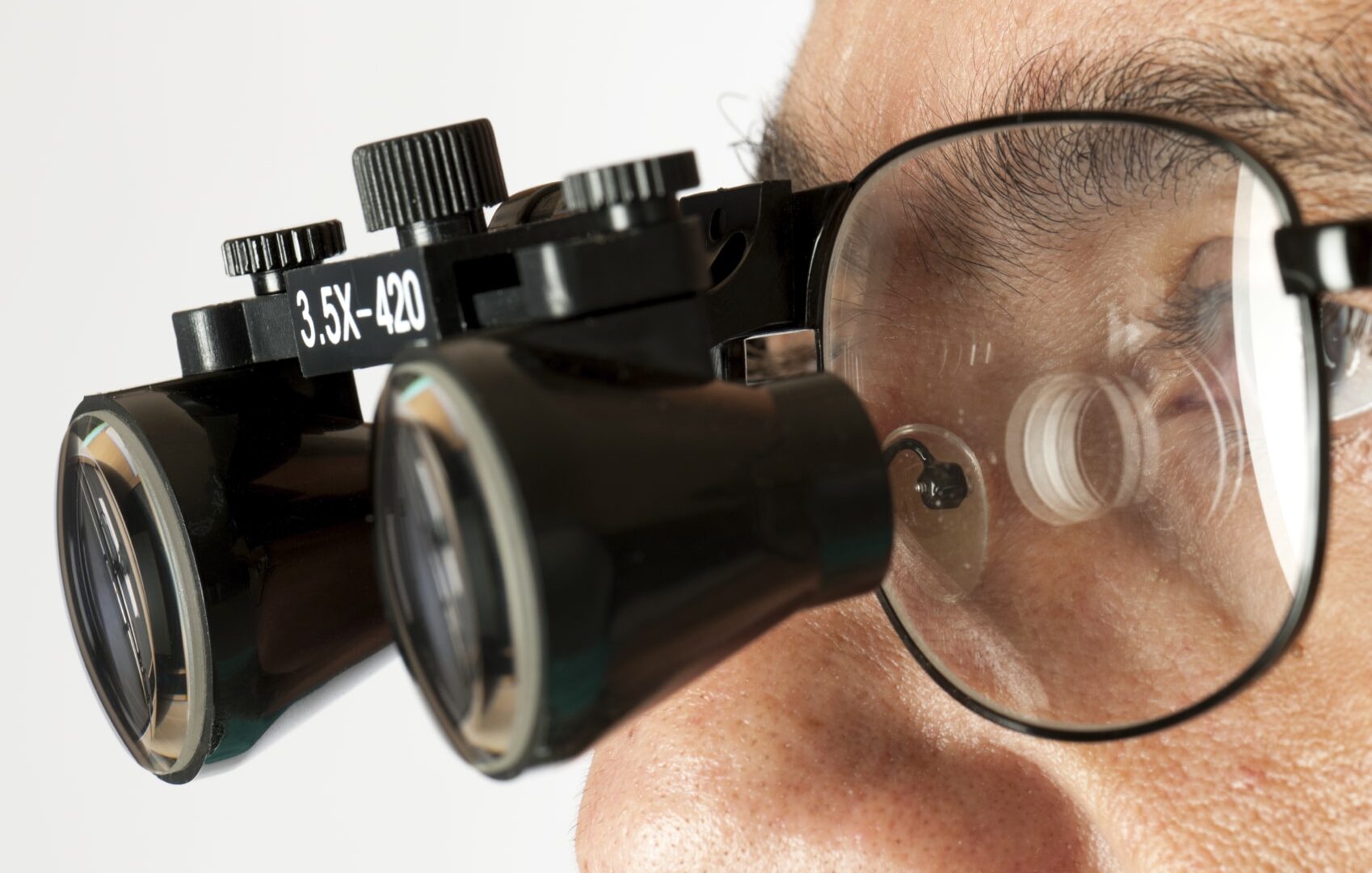
Illustrative photograph of magnifying loupes. The device shown is not one of the loupes used at smileDentity.
Careful treatment involves coordinating many individual steps. Magnifying loupes help us see and check our work. Stability, longevity and the appearance of a restoration remain our aims; however, they do not depend on optical magnification alone.
Imprecise steps can impair the result. We therefore combine professional planning and practised work with checks at each stage.
Research shows differing results: a randomised study found benefits in a simple two-dimensional task, particularly in the group with good visual acuity. No significant advantage was demonstrated for complex three-dimensional preparations. A 2026 pilot study emphasises the importance of training level and familiarity with the equipment. Both studies involved simulated tasks, not long-term observation of our patients. [2] [4]
Treatment areas
Where can magnifying loupes help?
We use magnifying loupes for procedures including root canal treatment, periodontal surgery and aesthetic treatments in the anterior and posterior teeth. We assess small structures and check individual steps. Whether and how we use the loupes depends on the specific case.
At smileDentity, magnifying loupes are part of our daily work in almost all areas of dentistry. We select magnification individually according to the treatment and application. We also use them during routine check-ups and clinical assessment as part of preventive care. This helps us see fine structures and changes in tooth tissue more clearly and assess them selectively.
In periodontal treatment the focus is disease of the tissues supporting the teeth. In the anterior region, the shape and transitions of a restoration can be important, for example with aesthetic front tooth fillings. Magnifying loupes are an aid within the respective treatment, not a treatment in their own right.
Understanding the technology
Distinguishing magnifying loupes from a dental microscope
Magnifying loupes are worn on the head. A dental microscope is a separate device with its own support system and a different optical design. The systems differ in magnification, handling and illumination, among other features. An article from the American Association of Endodontists describes these differences in the context of root canal treatment. [3]
Magnifying loupes and dental microscopes are therefore not equivalent. Findings about treatment under a microscope do not automatically apply to loupes either. We explain personally which aids are planned for your treatment and why.
Your treatment appointment
What will you notice as a patient?
Initially, you may not notice a clear difference from treatment without loupes. Magnification mainly changes our view of the working area. It is not anaesthesia and, on its own, says nothing about how comfortable you will find a treatment.
Before treatment begins, ask what is planned and which aids will be used. Also mention uncertainty or a wish for breaks. Individual preparation, possible anaesthesia and aftercare instructions depend on the underlying treatment.
Under optical magnification, we can identify fine anatomical structures, preparation margins and details of tooth tissue more clearly and work on them selectively. Fillings, crowns, bridges and veneers in particular depend on careful execution of many individual steps. At smileDentity, we therefore use magnifying loupes consistently. Greater visibility of detail is intended to support precision at every stage. The combination of carefully performed steps can contribute to the quality of a restoration; this does not promise a particular lifespan or treatment outcome.
At smileDentity
How do we work at smileDentity?
Andreas Haas, M.Sc., combines assessment of your findings with treatment planning. Magnifying loupes are part of our standard equipment. He and our dental hygienists use them as required in their respective treatments. For illumination, we use an LED system from the Ultra Smart PLUS product family. Responsibility for diagnosis and the approach remains with the treating dentist. We discuss with you who will provide your particular treatment.
Arrange a no-obligation introductory visit: we show you the practice, discuss your wishes and answer your questions. When requesting an appointment, you can describe your concern. We clarify which treatment is appropriate, who will provide it and what it will cost on the basis of your situation.
Frequently asked questions about magnifying loupes (FAQ)
The working area appears optically larger than when viewed with the naked eye. The figures refer to the different magnifying loupes at our practice. A higher number alone does not indicate how well a particular treatment will turn out.
Magnifying loupes are a standard tool at smileDentity. Andreas Haas, M.Sc., and our dental hygienists use them in their respective treatments when the task requires it. This does not mean they are used for every single treatment step.
No. Loupes are worn on the head; a microscope is a separate device with its own support system. Their design, handling and illumination differ. Statements about one system therefore cannot be applied generally to the other. [3]
Loupes provide optical magnification and do not replace anaesthesia. They cannot predict how you will experience treatment. Discuss concerns and the planned options for pain control before the procedure.
Preparation and aftercare depend on the planned procedure. We explain your individual instructions when planning the appointment. Optical magnification alone does not require an additional general preparation plan.
At smileDentity, we do not charge extra for the use of magnifying loupes themselves. They are part of our standard equipment. We clarify the costs of the underlying treatment and possible reimbursement separately beforehand.
Yes. During a no-obligation introductory visit, you can discuss your wishes and questions. We explain which treatment options suit your concern. A treatment decision requires individual findings.
Sources on magnifying loupes
The studies mainly examine simulated tasks. They do not establish a general guarantee of healing or longevity. The older AAE article is used to explain technical differences, not as a current equipment recommendation.
- [1] Wajngarten & Garcia, PLOS ONE (2019): Vergrößerungshilfen, Detailerkennung und Halsneigung bei 160 Zahnmedizinstudierenden am Phantom.
- [2] Eggmann et al., BMC Oral Health (2022): Randomisierte Crossover-Studie zur Präparationsgenauigkeit bei 59 Studierenden; simulierte Aufgaben.
- [3] American Association of Endodontists (Winter 2016): The Dental Operating Microscope in Endodontics. Technische Einordnung von Lupen und Mikroskopen.
- [4] Prause et al., BMC Medical Education (2026): Pilotstudie zu Lupen und Mikroskopen bei 60 Studierenden; standardisierte restaurative Simulationsaufgaben.
Sources and links last editorially checked on: 18 October 2026.
Questions about treatment with magnifying loupes?
Arrange an introductory visit without obligation — we show you the practice, discuss your wishes and answer your questions.
Medical review of the German source: On 18 October 2026, this content was reviewed by Andreas Haas, M.Sc. (dentist at smileDentity Dreieich) for medical accuracy, currency and scientific basis.